A recent favorite is a post on a magic trick using diapers!
]]>Several years ago, I left to slow-travel across the United States with my wife and kids.
This was a great time to take a step back and look at my management career. I was able to see what worked and what didn’t.
Somewhere along the journey, I started refining and writing down my learnings.
Over time, this transitioned to active coaching. I had the honor of working with more than a hundred different managers. Some were junior and some already managed managers. Some worked at startups and others worked at FAANG companies.
These interactions helped me further refine and hone my management frameworks. Yes, I learned a lot from active research from courses, books, and professional magazines. But, it was the multi-way interactions with a diverse set of humans that taught me the most.
Having a community of like-minded humans is a superpower.
This is why I am excited to announce the Management Deltas community.
After a few of months of trial-running this community, I am excited to invite you to join the community.
What can you expect?
You can join today and lock-in introductory pricing.
I’ll see you in the community.
]]>First thing first, let’s talk about how to manage yourself. When you have a back-to-back meetings day in the office, you have the luxury of walking between meeting-rooms in the space between meetings. If all your meetings are virtual, you no longer have this luxury. Combine this with the increased cognitive stress of talking to a flat monitor all day long, and you have the perfect recipe for finishing your days emotionally drained. In a remote environment it is even more important to be strict about managing time and leaving some space between meetings to get away from the screen. For meetings that don’t require going over written material, consider going audio-only and taking a walk outside. More than anything, take even 5 seconds to gauge how you are doing emotionally and take breaks when you need to.
Next, you should invest in a good technical setup. This includes having a good internet connection with decent upload bandwidth and a good wifi or wired connection to your router. Once the plumbing is in place, you have three more things to invest in: visual, audio, and screen. You want to make sure that others can clearly see you, which helps with non-verbal communication. This means getting a decent webcam — your laptop camera is not good enough. Beyond the camera, you also want to invest in good lightning. Ideally, you should invest in a 3-point lightning setup, with a key light highlighting your face at an angle, a fill light to illuminate the other side of your face, typically at a lower angle, and a backlight to make you stand out from the background. Regardless, you should make sure that people can actually see you. At a minimum, this means making sure that there are no bright light sources, such as an open window, directly behind you, and that you are in a well lit environment.
Now that people see you, you want to make sure that people can hear you. Simple wired headphone are great, as long as you don’t get tangled up with all of the wires. Bluetooth headphones are acceptable as long as the lag is not too large. If you have a day full of meetings, battery life may also be an issue. If you want to go all in, a dedicated microphone will be great, although you will want to invest time in setting it up properly. You may end up investing in headphones anyways and connect them to your microphone so that you can hear how you sound, which reduces cognitive load.
With audio getting feedback on how you sound is great, but for video the opposite is true. The very first change that you should make to your video conferencing software is to turn off self view. We all gravitate to looking at ourselves, which distracts us from looking at the people speaking on the other side. Making eye-contact is as important in video-conferencing as it is in in-person meetings, if not more so. Removing the self view will help you maintain eye-contact. Beyond that, make sure that you minimize distractions during the call. This is the one case where having multiple monitors is a downside. Make sure that all the screen real-estate that is not dedicated to the meeting is free from any notifications or distractions, so that you can focus on being present in the meetings.
With the logistics out of the way, let’s turn our attention to running effective remote meetings. The inherent lag in remote meetings with multiple participants makes it easy to cut people off unintentionally, or to enter an endless loop of “sorry, you go ahead.” To mitigate this, have an agreed upon protocol for switching between speakers, such as having a moderator decide who speaks next. Couple this with a system for “raising your hand,” either directly in the video conferencing software or in a dedicated chat thread for the meeting attendees.
Some of the normal meeting best practices become even more important in remote meetings. Taking notes and sharing the summary and action items is critical to making sure that everyone really is on the same page. It is much easier for misunderstandings to take place when we can’t read body language as easily and when some of the participants may have a spotty internet connection. It is also even easier in remote meetings for people who tend to be passive, due to shyness, minority status, or power dynamics, to not engage. As the meeting moderator, you should actively make sure that their voices are heard.
Finally, a note about mixed meetings, which are common in offices that reopened with reduced capacity. If you run a meeting in the office and people from a remote office or from home also dial into the meeting, you want to make sure that make the remote people are included in the meeting. At the start of the meeting, verify that the video is properly set up so that the remote attendees can see what everyone in the room is doing. If you have to jump between the whiteboard and the table, assign a “remote champion” who will control the camera so that remote participants can see how things are going. You should make sure that you can get fast feedback from remote attendees. Sometimes the microphone location in the meeting room can make the meeting complete incomprehensible for them, while everyone in the room is non the wiser. Finally, the remote people are at an inherent disadvantage, so make sure that you engage with them and that their input is heard.
Hopefully we can all return to the office soon, but we will have to continue collaborating with people working remotely moving forward.
]]>You can learn more about the concept over at nownownow.com.
]]>Facebook does not have a good track record of protecting its users’ data – both social data and security credentials. Facebook also came under fire for helping to spread misinformation (e.g. election interference attempts) and inappropriate data (e.g. hate crime videos). Mark Zuckerberg recently responded with two posts addressing each of these problems: “A Privacy-Focused Vision for Social Networking” and “The Internet needs new rules. Let’s start in these four areas.” respectfully. From talking with several insiders, the company is taking these changes seriously.
I care about privacy more than the average person. I rarely use Google to search the web – DuckDuckGo does an okay job most of the time. I pay money to my email provider (FastMail) instead of using GMail. I also self-host the analytics for this blog instead of using Google Analytics. I also realise that most people have different priorities and choose to use these services.
The inherent fundamentals of social networks dictate an advertising-based business model, which requires making trade-offs with users’ privacy. If these transactions are transparent and clear to users, the business will provide a win not just for itself and its customers (advertisers), but also to its users. As someone who lives a short 11,000 kilometers (6,800 miles) from family and friends, I can attest that the value is real.
Facebook needs to improve in: (a) Security; (b) Privacy; and (c) Integrity. The last one is difficult both from a technical and from a societal perspective. How can we identify if each post is a Hate post? How quickly? Who gets to define what is inappropriate? I look forward to trying to tackle these problems.
When disaster strikes, you should run towards the source of the problem, not away from it.
]]>
A recent favorite is a post on a magic trick using diapers!
]]>
It wasn’t easy getting here, because Trust is still mostly centralized. In the US, your financial situation is synthesized into a single number decided by three private for-profit organizations. This number is of course the Credit Score. Coming from a different country means that this number simply doesn’t exist.
The score was designed to signal a person’s credit-worthiness. Even as such, it is quite broken. There are stories of very high net worth individuals who couldn’t get approved for a credit card. For the majority of the population, however, it does the job. For the outliers, it takes some time.
Unfortunately, the score isn’t used only for deciding whether to trust a person with a credit line. When I was here preparing everything before the family arrived, I had to keep explaining to property owners that I don’t have a credit score. One owner in particular refused to speak with me, even when I offered to prepay for the place. This is because the credit score is also used as a Trust Score.
To add insult to injury, the system is broken because there is no formal unified identification at the federal level. In its place, the Social Security number is used, and it was never designed for this. This means that even the existing system designed to quantify trustworthiness is built on shaky ground. This was exemplified with the latest Equifax hack.

Quantifying trust is an interesting challenge. In the private sector, insurance companies have the longest history trying to solve this problem. These companies have been very slow to use the abundance of information that exists today to improve their scoring function. The heavy regulation has made it very difficult for newer companies to try and disrupt the field, with the notable exception of newcomer Lemonade. It took very experienced and successful entrepreneurs to be able to raise enough capital to rise up to the challenge.
Historically, however, quantifying trust was mainly performed by the government, in the view that it is an impartial third party. That’s why getting into a taxi was supposed to be safer than hitchhiking – you knew that the regulator reviewed the driver and gave them a medallion. I believe that even with all the scare stories, the new entrants in the private sector are doing a better job. Using ongoing input from the actual users gives a score that is more accurate over time.
This is why I was very happy to learn of a new company trying to tackle this issue in the credit field. It’s a company that provides a credit card without a credit check, as well as increasing transparency in the field. This company is Petal. I am currently in the waiting list, I’ll keep you updated.

We tried to take advantage of the wonderful weather to travel as much as possible. There are many wonderful parks and trails in and around Seattle.
The people here have been absolutely fantastic, and everyone has gone out of their way to help us out. I cannot thank them enough – what a wonderful welcome.


As such, I’m currently looking for a new place where I can do great work, all while Making the World a Better Place™. If you think we would be a good fit, let’s talk:

Nearly every person living in a modern country has access to both, and utilizes both. Most of us enjoy the benefits received through capital investments, at least through retirement funds.
Historically, investing one’s capital in a low-cost index fund tracking the US Stock Market (such as the Vanguard 500 Index Fund which tracks the S&P 500) has done very well. This is still the method I follow for the bulk of my assets. However, as can be seen in the figure below1 (taken from a FundersClub guide) most value creation is moving from the post-IPO to the pre-IPO stage. This means, that as time moves on, ordinary people, who are forbidden from investing in private companies, are less and less capable of reaping the rewards of growth.

Back in early 2015, I discussed the effect this has on inequality and the importance of the JOBS act in Venture Capital and Equality. Well, on May 16th, 2016, Title III of the JOBS act went into effect (similar changes will come into effect in Israel by the end of 2017). This means that ordinary people, who are not wealthy accredited investors can now invest in startups. There are many online crowdfunding platforms which allow everyone to invest in startups from the comfort of their home, with the most prominent being Wefunder 2.
This even includes people who are not US citizens.
Great! Except, not exactly. We need to discuss the downsides first.
There are many risks to investing in startups, and I’m not going to talk about them. What I want to do is outline the problems with startup investing for new non-accredited investors under the new regulation. As always with regulation, there are unintended consequences and second-order effects.
Being a publicly traded company entails a lot of headaches: having to follow US GAAP (generally accepted accounting principles), providing quarterly reports to shareholders, etc. The thinking behind these regulations is to make sure that potential investors have as much knowledge as possible at their disposal before making a decision to invest. One of the main reasons companies opt to stay private for so long is to avoid all the overhead required to provide this transparency. In order to protect investors in private companies, the regulation requires that they be accredited investors – wealthy individuals who can afford to make some bad bets.
The JOBS act allow non-accredited investors to invest in private companies. In order to protect them, it imposes new regulation on the startup raising money (mainly following GAAP and having external accounting audits). And here’s the thing: this is still an expensive headache, especially for a young startup. Which means that companies that can avoid raising money using the new regulation will most likely go the old fashioned way – from accredited investors. This, in turn, means that the potential for finding good startups using Regulation Crowdfunding is lower. As Mesh Lakhani says, “Access is a very important factor in venture investing”, and you will have significantly less access than accredited investors.
The next downside is that even with all the new regulation, startups do fail all the time. The potential for losing all of your investment is much higher than when investing in an S&P 500 company. There is nothing special here – this has always been the case, except that now the general public is exposed. In order to mitigate this risk, the JOBS act places a limit on how much an individual can invest per year, as a function of yearly income and net worth, thus ensuring that people don’t bankrupt themselves investing in startups.
One of the benefits of the new system is that you can invest even very small amounts of money, thus allowing you to diversify without taking a second mortgage. However, this also inadvertently leads to another major issue. If a company succeeds 3 and reaches another round of financing, such as a major seed or A round, then traditional VCs will enter the picture. For justifiable reasons, these more institutional investors do not want a messy Cap Table. That is, they don’t want to see a company with thousands of different investors, from whom they will have to collect signatures before certain actions can take place. In order to mitigate the risk of this scaring away future investors, many contracts will include a clause that separates major investors (usually accredited investors who put up at least 25,000$) from smaller ones. The latter will then give up their voting rights to a designated investor, who may even force them to sell their shares prior to a new financing round. This is not always the case, but it is definitely something to look out for.
Finally, even with the new regulation, the transparency is very low. Prior to investing a person should consult all of the available information, including Form C and the financial documents (balance sheet, income statement, cash flow, and stockholder equity), try and find as much information about the company using the internet and acquaintances, etc. How to conduct due diligence warrants a dedicated post.
Startup investing is risky, and especially more so for non accredited investors4. Nonetheless, I think this is a wonderful development.
You can head on over to Wefunder and start looking around. Investments can start in as low as 100$ (that’s one hundred dollars).
The figure is obviously misleading, since you need to normalize to time-since-IPO. Nonetheless, the trend does appear to be real. ↩
One can argue if this really constitutes success. See Reconsider by DHH ↩
That’s an affiliate link that will give both of us 10$ ↩
The regulation increased the risk where it sought to reduce it. This is not surprising. ↩
It’s a heated election, to put it mildly. One of my friends wrote a quick post on the subject, with the following image:
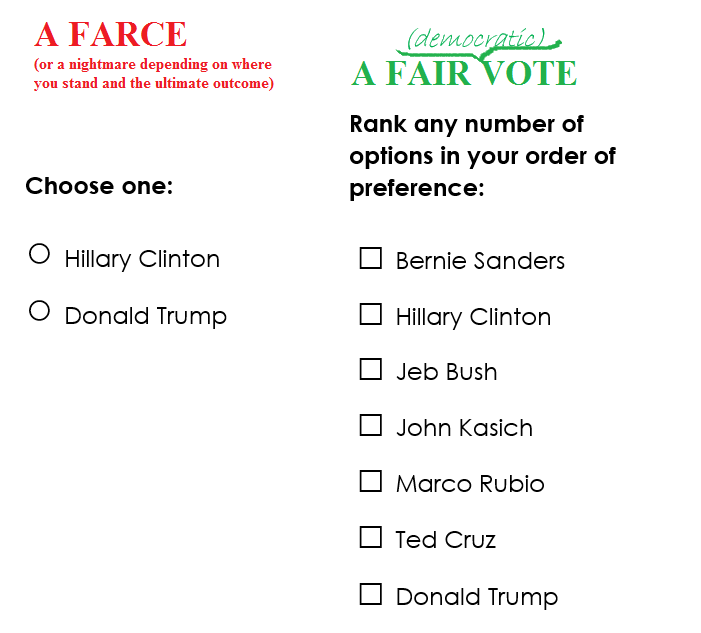
While I agree that there is place for election reform, I disagree with the lefthand part of the image.
So, a little backstory, which took place far far away, not that long ago.
In the 2006 general elections in Israel, the Pensioners of Israel party ran for office, along with many other esoteric parties. They never had a chance to pass the threshold for winning seats. This time, however, the party won about 6% of the positions in the Knesset, and were part of the coalition government.
The interesting thing is that most of its voters were quite young. It was a protest vote. Many people believed that there was no good choice, so they protested.
Back to the current election.
Trump is a bad choice.
Hillary is a bad choice.
But these are not the only choices.
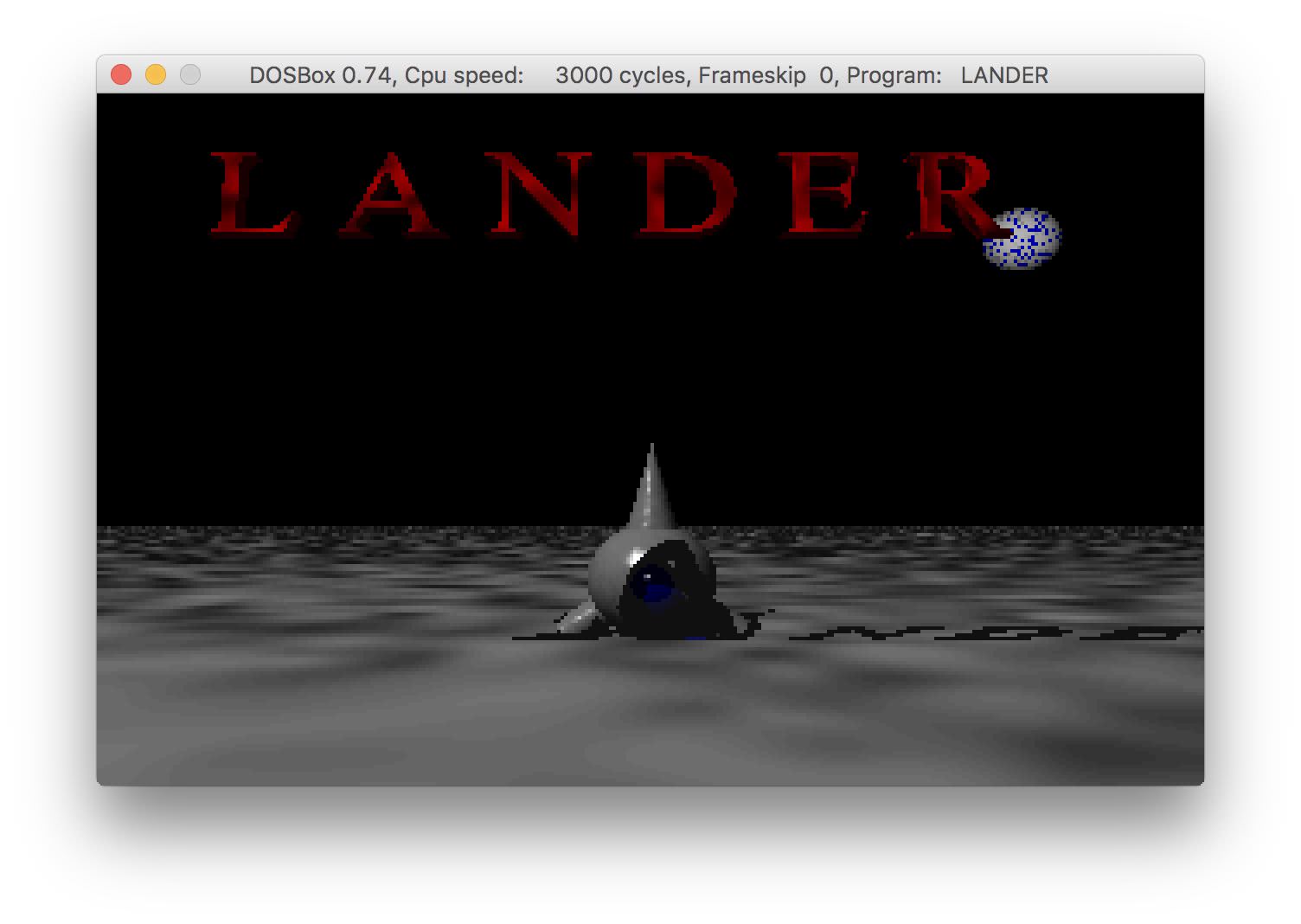
]]>I was going over some of this old data recently when I came upon a game I developed in 1998. The documentation said that it was licensed as freeware. Sadly, this has never been released into the wild. This probably has something to do with the following gem I found in one of the files Pavel sent me at the time:
I have copied you only small part of the files, because it would be too big to send by modem.
Alas, the source code for the game did not survive.
I created the splash screen graphics in POV-Ray. The code, as far as I recall, was written in a mix of C and x86 assembly.
Click here to download lander.zip
In order to run the game, you should install DOSBox, unzip the contents to a directory on your machine, and mount it within DOSBox:
MOUNT C ~/LANDER
C:
CD LANDER
LANDER.EXE
Press ENTER to continue when it’s ready and to advance after the splash-screen.
Enjoy!